
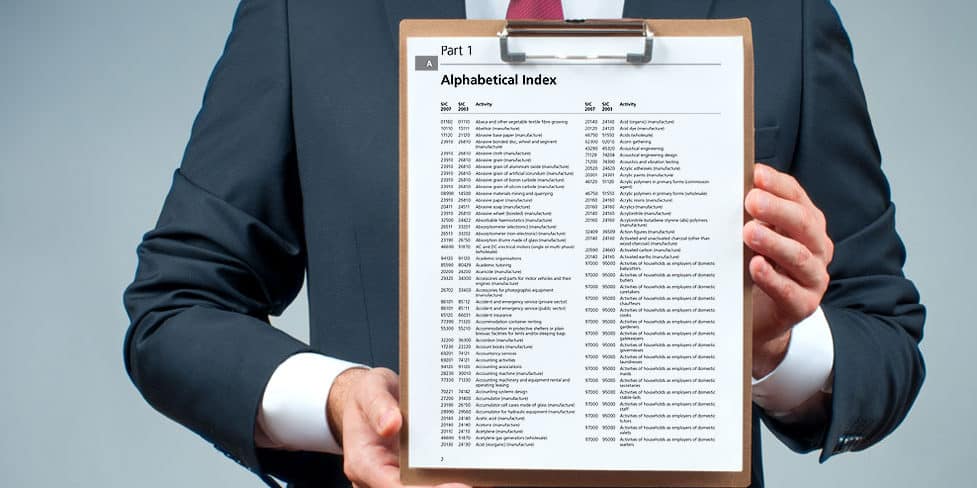


When you register a limited company, Companies House asks you to choose your SIC codes – and some founders have no idea what that means.
SIC codes are five-digit numbers, each representing a particular business activity. You choose between one and four from an official list when you incorporate, picking the codes that best cover what your company’s intended activities.
The tricky part is matching what you do to a code on that list. For example, if you run a coffee van, are you a café, a takeaway, a mobile food stand – or all three? Read on to learn how SIC codes work, how to find the right one, and why choosing an accurate code matters.
Key takeaways
- SIC codes are five-digit numbers that each represent a business activity.
- When you register a limited company, you must select at least one SIC code to tell Companies House what your business will do.
- You can list up to four SIC codes and change them through your confirmation statement whenever your business changes. There is no separate charge for updating the codes other than the confirmation statement filing fee.
- Your SIC code doesn’t affect your Corporation Tax or restrict how you can legally trade.
- Banks, insurers, and lenders may check it when reviewing applications, and HMRC asks for it when you claim Research & Development (R&D) tax relief and in some other instances, such as when registering for VAT – so it’s worth paying attention to.
What are SIC codes and how do they work?
SIC codes, short for Standard Industrial Classification codes, are five digits long, and each one represents a single business activity. When you register a company, you report between one and four of them to Companies House, depending on how many activities your business engages in. Together, they tell Companies House and the public what your company does. They’re sometimes called limited company SIC codes, and every company on the register has at least one.
Companies House uses SIC codes to record your business activity and group companies by industry. The Office for National Statistics uses the codes to measure the UK economy by sector.
There are millions of companies on the Companies House register, and all have at least one SIC code. Be aware that your SIC code isn’t the same as your company registration number. Your registration number identifies your company, while your SIC code describes what it does.
How to select your company’s SIC codes
When registering a UK company, you need to select the correct SIC codes to describe your business activities. But what exactly are SIC codes, and how do you choose the right ones?
Why does your company need a SIC code?
It’s a legal requirement. You can’t finish the incorporation process without choosing at least one SIC code. It’s also a legal requirement to keep them up to date throughout the life of your company.
Your code appears on your public record, next to your company name, registered office, and directors, so anyone can look it up.
Companies House SIC codes let government bodies, researchers, and other businesses quickly see what a company does, and sort companies by sector. They’re primarily tools for classification and official statistics, but they also have practical impacts on your business.
How to find the right SIC codes for your business
When you incorporate, you’ll see a field labelled “Nature of business (SIC)”. You pick your codes from the condensed list of SIC codes published by Companies House, and you must use the codes from that official list. Here’s how to find yours:
- Describe what your business does, in plain words. Focus on the activities, not the product.
- Open the condensed list of SIC codes on the Companies House website and search for the keywords for those activities.
- Read the matches and choose the ones that best fit your activities.
- If nothing matches exactly, use the closest general description. Many codes end in “n.e.c.”, meaning “not elsewhere classified”, for exactly this reason. If nothing seems to match, you should look at choosing more than one code to get the best possible coverage of your activities.
Some descriptions are very specific, such as “Growing of grapes” or “Plastering”. Others are broad, such as “Other business support service activities n.e.c.” or “Physical well-being activities”. The list is wide-ranging, but not exhaustive, so if a single code doesn’t quite cover what you do, you can add more.
If you’ve already incorporated and can’t remember which codes you chose, you can find it on your Companies House record.
SIC code list examples
Companies House uses a condensed version of the UK SIC 2007 classification maintained by the Office for National Statistics.
Here are the 21 sections, and within each, you’ll find many subsections that contain the specific codes for each activity.
| Section | Industry group |
|---|---|
| A | Agriculture, forestry and fishing |
| B | Mining and quarrying |
| C | Manufacturing |
| D | Electricity, gas, steam and air conditioning supply |
| E | Water supply, sewerage and waste management |
| F | Construction |
| G | Wholesale and retail trade; repair of vehicles |
| H | Transport and storage |
| I | Accommodation and food service |
| J | Information and communication |
| K | Financial and insurance activities |
| L | Real estate activities |
| M | Professional, scientific and technical activities |
| N | Administrative and support service activities |
| O | Public administration and defence |
| P | Education |
| Q | Human health and social work |
| R | Arts, entertainment and recreation |
| S | Other service activities |
| T | Households as employers |
| U | Activities of extraterritorial organisations |
Example SIC codes by business type
Once you’ve found your section, here are some common examples of businesses alongside their SIC codes:
| Business type | Example SIC code | Description |
|---|---|---|
| Online retailer | 47910 | Retail sale via mail order houses or via the internet |
| Management consultant | 70229 | Management consultancy activities (other than financial) |
| Café | 56102 | Unlicensed restaurants and cafés |
| Software developer | 62012 | Business and domestic software development |
| Hairdresser or salon | 96020 | Hairdressing and other beauty treatment |
| Freelance designer | 74100 | Specialised design activities |
How many SIC codes can you use?
You can use up to four SIC codes at once, and you must have at least one.
If your business does more than one thing, add a code for each main activity. For example, a restaurant that also runs a takeaway and operates a wine shop might use three codes: 56101 for the licensed restaurant, 56103 for the takeaway, and 47250 for the retail sale of beverages.
There’s no benefit to adding codes for work you don’t really do, so choose the ones that reflect what your business does.
The important thing, however, is to ensure you have good coverage for all your activities.


Does your SIC code affect tax or what your business can do?
This is a common worry, and the answer is that your SIC code doesn’t limit what your company can legally do. Your codes describe your activities; they don’t determine them. A company can trade in any lawful activity, unless its own articles of association restrict it.
Your SIC classification codes also do not affect your Corporation Tax. HMRC works out your tax from your profits, not from your code.
There are a few tax-related points worth knowing about, however. For example, since 8 August 2023, every R&D tax relief claim must be supported by an Additional Information Form, which asks for your current SIC codes. Your codes do not determine whether the claim qualifies, but they form part of the information HMRC receives when reviewing it.
If you plan to claim R&D relief, make sure your SIC codes accurately reflect your company’s main business activity.
Additionally, when you register for VAT, HMRC asks about your business activities and uses that information to classify your business. Your Companies House SIC code doesn’t determine whether you must register for VAT or what VAT rate you charge.
Why banks, lenders, and insurers care about your SIC code
Banks, lenders, and insurers are known to check SIC codes when they assess your business for applications, for example, when you apply for a business bank account.
Some have sectors they won’t serve, such as cryptocurrency, gambling or money transfer, and a code that falls into one can get your application declined at the screening stage.
Lenders and credit reference agencies may also use your code to assess the risk of lending to you. If your code(s) suggest a higher-risk sector than the one you trade in, you might be offered a smaller loan, a higher interest rate, or no credit at all. Similarly, insurers may use it to calculate your premium.
You should check your code and ensure it’s accurate before you apply for finance, insurance, or a business bank account.
Can you change your SIC codes after incorporation?
You’re not locked into your first choice.
To change your company SIC codes, you update them through your confirmation statement, the annual filing that keeps your company details current with Companies House. There’s no separate fee for the change, though filing the confirmation statement itself costs £50 online, or £110 by post. If you’d rather not file it yourself, our Confirmation Statement Service takes care of the filing for you, including updating your SIC code and any other details that need changing.
You don’t have to wait for your annual confirmation statement deadline. You can file an early confirmation statement if you need to immediately change the SIC code(s) associated with your business. It’s good practice to update the codes as soon as possible, if you know they need to change.
What if you provide the wrong SIC code?
If you choose the wrong SIC code by mistake, fix it as soon as possible. An inaccurate code can lead banks, lenders, and insurers to misjudge your business, and Companies House may query, reject, or remove information that appears incorrect or misleading.
With that said, an honest mistake is different from filing information that is materially false, deceptive, or misleading without a reasonable excuse. Doing so can be a criminal offence under the Companies Act 2006.
- What happens if you use the wrong SIC code?
- What is a confirmation statement?
- What is a company registration number (CRN)?
How to find your SIC code after registration
Once your company is registered, your SIC code becomes part of its public record, so it’s easy to look up if you’ve forgotten which one you chose.
The quickest way is to search your company on the Companies House register. Your SIC code is listed on your company’s overview page, alongside details like your company number, registered office and directors. Anyone can view it, so you don’t need to log in to check.
If you formed your company through 1st Formations, you can also find your SIC code by logging in to your account.
SIC codes for dormant and non-trading companies
Even a company that isn’t trading needs a SIC code, and two codes exist for this.
Use 99999 as the SIC code for a dormant company. For Companies House, a company is dormant if it has had no significant accounting transactions during the financial year, apart from a small number of permitted transactions such as certain Companies House filing fees. That being said, just because you report 99999 as your SIC code does not itself mean your company is dormant.
Use 74990 for a non-trading company. This covers a company that isn’t trading but isn’t dormant either, because transactions are still going through the company’s books (e.g. overhead costs).
When a dormant company starts trading, you can change its code on the next confirmation statement to one that describes its current trading activities.
Get your company set up correctly from the start
Your SIC codes are a small part of forming a company, but they’re one you need to get right, since they affect how others see your business.
The reassuring aspect of all this is that it’s rarely an overly difficult choice and not a permanent one. Choose the code that best fits what you do now, and update it in your confirmation statement if needed in the future. Be especially aware of your SIC codes if you’re applying for a loan, insurance, or intending to claim R&D tax relief.
If you’re ready to begin, you can register your company with 1st Formations in minutes, and our team can help you choose a code that fits. Take a look at our company formation packages to find the right one for you, and get your business set up properly from the get-go.





Join The Discussion