
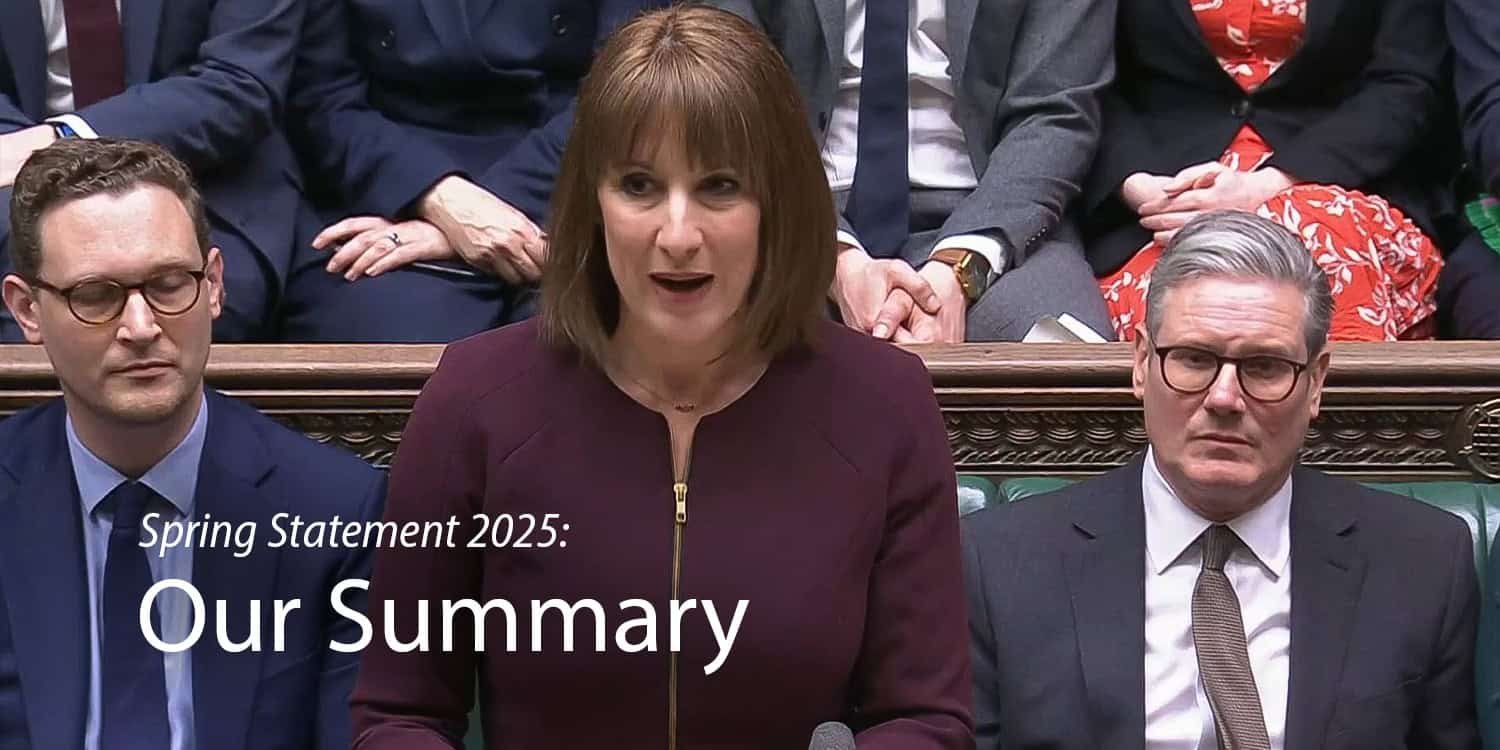

Chancellor Rachel Reeves delivered the Spring Statement 2025 on 26 March. While it’s not a full Budget, this mid-year update gives a snapshot of the UK’s finances and sets the tone for future tax and government spending decisions.
With the pressure of low economic growth, the Chancellor outlined spending cuts to fill the £15bn fiscal hole compared to the plans she announced in the Autumn Budget. Reeves emphasised the government is “on the side of Britain’s working people, working in their interest” and did not place UK businesses at the core of her speech.
Key takeaways
- Chancellor Reeves projects a cautious economic recovery, with GDP growth forecasted at 1% for 2025, down from previous estimates.
- Increased National Insurance contributions and wage rates in April 2025 will significantly raise payroll costs for SMEs.
- The government’s investment in construction training aims to address skills shortages and support workforce development in the sector.
However, there are still important economic updates to be aware of. Here are the key points covered in the Spring Statement and what they mean for businesses like yours.
How is the current state of the economy affecting businesses?
The point of this Spring Statement, ultimately, was to outline the economy’s health. Real gross domestic product (GDP) growth has fallen short of expectations. It is now forecast to grow at 1% for 2025, down from the 2% initially predicted by the Office for Budget Responsibility (OBR) in the Autumn Budget.


However, inflation measured by the Consumer Prices Index (CPI) fell to 2.8% in February 2025 from 3% in the 12 months to January 2025. Also, real household income will grow this year at twice the rate expected in autumn and household disposable income is expected to grow. After considering inflation, the OBR stated today that people will be over £500 a year better off on average under this Labour government.
Typically, when the economy is lagging, consumers tend to cut back on spending – especially on non-essential goods and services. However, with CPI falling and household disposable income growing, business owners can hopefully look forward to consumer confidence improving in 2025.
How will the future state of the economy affect businesses?
The government’s spending changes announced today intend to balance the budget and grow the economy over the coming years. The Chancellor reports:
“I can confirm to the House that the OBR have [as a result of reforms announced today] upgraded their growth forecast next year and every single year thereafter, with GDP growth of 1.9% in 2026, of 1.8% in 2027, 1.7% in 2028 and 1.8% in 2029.”
Reeves concludes: “There are no quick fixes, but we have made the right choices to return stability to our economy after years of mismanagement by the party opposite, delivering security for our country and security for working people.”
If these forecasts are met, it could create a more stable long-term environment for business planning, investment, and sustainable growth.


Key changes affecting the construction sector
The government announced it will support the construction industry by investing £100 million in 35,000 additional training places in construction-focused Skills Bootcamps. This will benefit trainees, ‘returners’, and existing employees.
- Support for entrepreneurs: Here’s where to start
- Key dates in 2025 small businesses need to know
- How salary sacrifice can cut Employers’ National Insurance bills
Additionally, the government will provide a further £40 million to support up to 10,000 more young people to access new construction Foundation Apprenticeships, enabling more young people to enter the industry and address skills shortages.
Reminder: changes coming in April 2025
Though the Chancellor did not mention the new policies and taxes taking effect next week in her speech, they are significant to businesses’ financial outlook. Here are the five key changes to keep in mind:
- Employer National Insurance contributions (NICs) increase from 13.8% to 15%.
- Employment Allowance is rising from £5,000 to £10,500.
- The National Living Wage (NLW) is rising from £11.44 to £12.21 per hour for employees over 21. The National Minimum Wage (NMW) for employees between 18 and 20 will rise from £8.60 to £10.00 per hour. The apprentice wage also increases from £6.40 to £7.55 per hour.
- Late payment penalties for VAT and income tax Self Assessment will increase from 2% to 3% at 15 days, 2% to 3% at 30 days, and 4% to 10% from day 31.
- Capital Gains Tax on the sale of shares will increase from 20% to 24% unless the sale qualifies for Business Asset Disposal Relief. Business Asset Disposal Relief will increase from 10% to 14% on 6 April 2025 and then again to 18% from 6 April 2026.
For more details on what’s changing for the 2025/26 tax year, read our Autumn Budget Report for SMEs.
UK businesses’ sentiment on the Spring Statement 2025
Many entrepreneurs had hoped the Chancellor would signal more support towards businesses and put their needs at the core of the country’s economic recovery.
SMEs are about to deal with significant rises in costs this April due to employers’ National Insurance contributions rising by 1.2% and increases in statutory wage rates. Dext research shows that as a result, a third of business leaders are losing sleep over concerns about affording their payroll costs, and the Companies House register shrank between October and December 2024 for the first time since quarterly records began in 2012.
Graeme Donnelly, founder and CEO of 1st Formations, provided his analysis of today’s events.
This Spring Statement fell short of what businesses need. Rather than laying the groundwork for growth, it offered little in the way of direct investment. SMEs drive the UK economy, generating over £2.4 trillion in turnover and employing 60% of the private sector workforce. Yet, the government is not prioritising them. Since the Autumn Statement, 24% of small businesses have cancelled hiring plans, and 16% have been forced to cut employee hours. If the UK economy is to recover and grow, SMEs need better, more targeted support.
Although businesses were not at the centre of this Spring Statement, we hope a positive economic outlook will benefit the UK business landscape over the longer term.
Stay tuned for our coverage of the Autumn Budget in October. We anticipate more substantial tax and policy changes.





Join The Discussion
Comments (2)
I am coming to office for consultation about important issues. See you soon.
Dear Tolga,
Thank you for your kind comment!
Unfortunately, as an ecommerce company, we do not facilitate in person meetings at our office.
However, we would be more than happy to assist with any query you may have via call, email or live chat. We do apologise for any inconvenience.
Kind regards,
The 1st Formations Team