
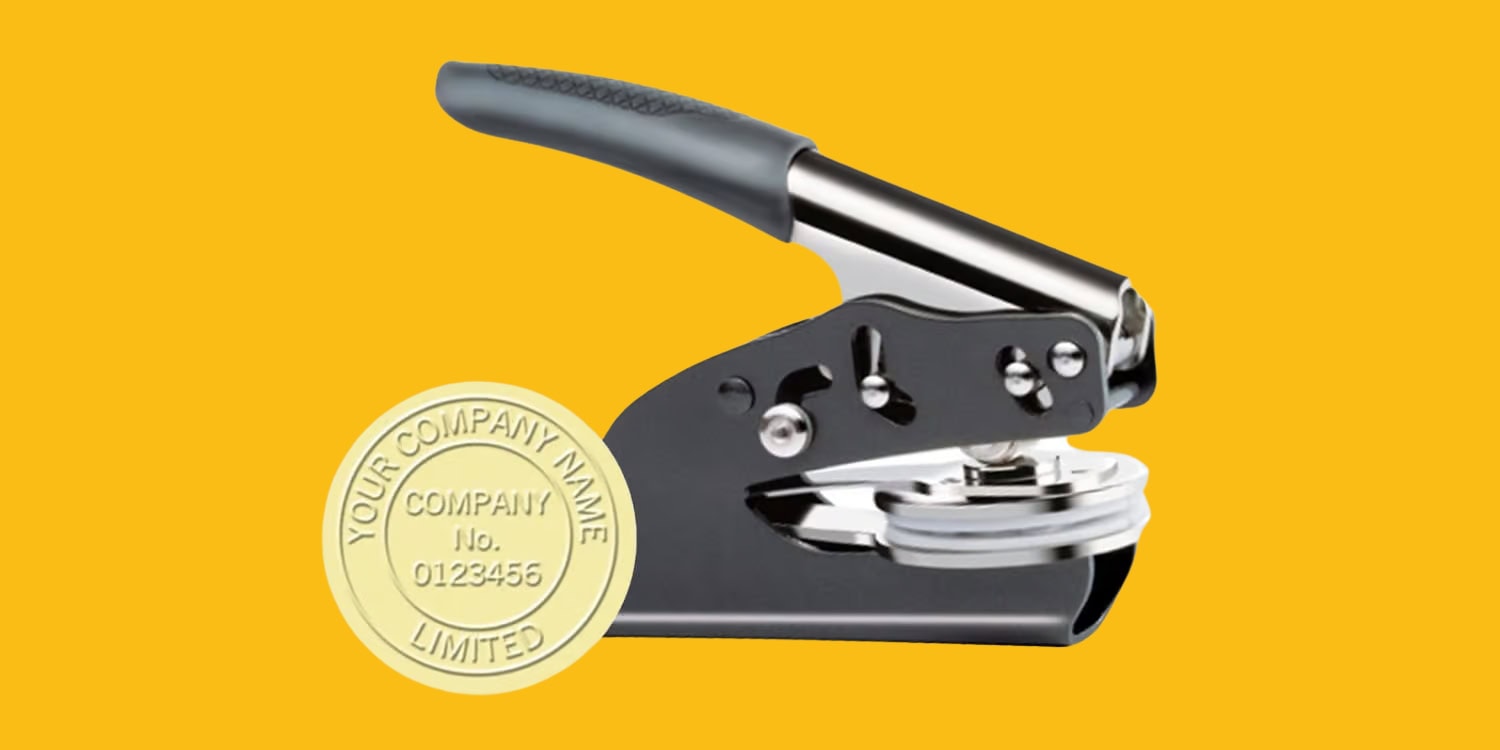

A company seal is an official stamp that authenticates documents on behalf of your business.
For hundreds of years, seals have traditionally served as a company’s signature on contracts, share certificates, and other documents. While UK law no longer requires company seals, some businesses still use them – particularly when dealing with international clients or conducting property transactions.
Read on as we explain what a company seal is, whether you need one, and when it might benefit your business.
Key takeaways
- Company seals are not legally required in the UK – you can sign documents with authorised signatories instead.
- Seals can be useful for international business, property transactions, and building credibility in traditional sectors (legal, accounting, etc).
- If you use a seal under the model articles, you’ll need an authorised signature and witness unless directors pass a board resolution.
What is a company seal?
A company seal, also known as a common seal or corporate seal, is a stamp that signs documents on behalf of your company, like a corporate signature. It’s customised to your organisation and displays your registered company name and incorporation number.
- What is an objects clause?
- Do I need to appoint a company secretary?
- Do I need a shareholders’ agreement when I set up a company?
Traditionally, company seals were stamps made of wax. A letter would be sealed shut, hot wax poured onto the paper, and a signet ring or engraved stamp pressed into the wax to create the company seal.
Modern company seals are usually embossers – small clamp-like devices that sandwich paper between two round metal plates. When pressed together, they leave your company details engraved or embossed into the document, creating a raised impression you can see and feel.
Features of a company seal
To sum up, a company seal normally:
- Shows your company’s registered name (mandatory by law)
- Displays your company number
- Creates a permanent raised impression on paper
- Typically circular, though oval and rectangular options exist
The seal must feature your company’s registered name in legible characters. Under Section 45 of the Companies Act 2006, using a seal with an incorrect registered name is an offence for which both the company and its officers can be held liable.
What is a company seal used for?
Company seals are commonly used to authenticate various business documents:
- Legal contracts and agreements
- Share certificates
- Articles of association
- Board meeting minutes
- Financial documents and loan agreements
- International business contracts
- Apostilled documents for overseas use
While seals are optional in the UK, they’re still recognised for any document where you want to show the highest level of company authorisation and authenticity.
Legal requirements for using a company seal in the UK
You don’t need a company seal to run a UK limited company. The legal requirement was abolished in 1989, and most businesses now use authorised signatures instead.
However, certain documents require “formal execution” – a specific legal process for signing. Formal execution may involve affixing a company seal, if the articles of association permit.
Understanding when these rules apply and how seals fit into this process helps you decide if one might benefit your business.
When do formal execution rules even apply?
Most business documents don’t require any special formalities. A single director can sign everyday contracts, invoices, and agreements without the need for witnesses, a company secretary, or seals.
The formal execution rules under Section 44 of the Companies Act 2006 only apply to specific documents, such as:
- Certain security documents (charges, mortgages)
- Some high-value or complex agreements where parties want maximum formality
For everything else – your standard supplier contracts, service agreements, employment contracts – you typically sign as a director.
The Companies Act 2006: Your options for formal documents
When you do need to formally execute a document under Section 44, you have three options:
- Use a company seal in accordance with your articles of association, or
- Have two authorised signatories sign (any two of: directors, company secretary), or
- Have one director sign in the presence of a witness who attests the signature.
Authorised signatories include all directors and the company secretary (if your company has appointed one).


If you’re the only director and don’t have a company secretary, executing deeds requires option 3: your signature and a witness. This is where option 1 – using a seal – can be useful for authenticating large volumes of documents, or when operating in overseas jurisdictions that expect seals.
Model articles of association rules
Many private limited companies formed since 2006 operate under the model articles of association – a standard set of company rules. Under the model articles, a company seal may only be used with the authority of the directors. The directors also decide:
- Whether to use the seal at all
- What the seal should look like
- How it must be applied to documents and when
Unless the directors decide otherwise, a document bearing the company seal must also be signed by an authorised person in the presence of a witness. An authorised person is a director or the company secretary (if the company has one).
Because of this rule, a company seal is usually used alongside a signature and a witness, unless the directors decide to change its use.
Company seal vs. authorised signatures
How a document is signed depends on whether the company is using a seal under the model articles as written, whether the directors have decided to allow seal-only use, or whether the company is not using a seal at all.
| Document type | Using a seal under the model articles | Not using a seal |
|---|---|---|
| Contracts | Seal plus one authorised signature and a witness | One authorised signature |
| Deeds | Seal plus one authorised signature and a witness | Two authorised signatures or one signature plus a witness |
| Share certificates | Seal plus one authorised signature and a witness | Two director signatures, or one director and one witness |
A company seal is most useful when directors have decided to allow seal-only use, or when additional formality is helpful, such as for deeds or international transactions.
When to consider using a company seal
While not legally required, company seals offer practical benefits in specific situations as follows:
For international business
Many countries still require or expect company seals on official documents:
- China (seals called “chops” are fundamental to business culture)
- Ireland (commonly used, though no longer mandatory)
- Greece
- Italy
- India
- Many Middle Eastern countries
- Various Asian markets, including Malaysia, Singapore, and Hong Kong
All in all, if you’re expanding internationally or working with foreign clients, using a company seal is good practice, if not essential.
For property or legal transactions
If your company regularly handles property transactions, a company seal provides additional legal protection.
Under the Law of Property Act 1925, documents bearing a company seal are presumed valid unless proven otherwise, provided the seal has been duly attested. This legal presumption can be valuable if anyone questions a property transaction after completion.
This matters most for:
- Property development companies
- Estate agencies
- Property management firms
- Commercial landlords
- Construction companies
- Investment companies acquiring property assets
For building authority and trust
A company seal creates an air of tradition and authority, which can enhance your professional image in certain sectors. When this perception matters:
- Legal services (law firms, solicitors)
- Financial services (banks, investment firms)
- Established professional services (accountancy, consultancy)
- Family businesses
- Traditional industries (property, manufacturing, shipping)
As you can see, the classic permanence of a seal suits time-tested business practices in formal sectors.
For fraud prevention
Company seals offer tangible security benefits:
- The seal must be stored securely with controlled access
- Only authorised personnel can use it
- Physical embossed seals are difficult to replicate
- Creates a clear audit trail under model articles
- Acts as a deterrent against casual fraud
Fraudsters increasingly target small and medium-sized enterprises (SMEs). A company seal adds a physical layer of protection that may be harder to bypass (or simply less attractive to defraud) than signature-based systems alone.
Want to use a company seal? Consider these steps
Under the model articles, a company seal may only be used with the authority of the directors.
The directors also have the power to decide how the seal is used and who may use it on the company’s behalf.
The directors can approve a change by passing a routine board resolution.
The decision is usually made at a board meeting, which can be held in person or remotely. If your articles permit, it can also be made by a written directors’ decision.
Under the model articles, a resolution passed at a meeting is approved if a majority of directors entitled to vote agree at a quorate meeting (one where enough directors are present to make valid decisions, as specified in your articles). For sole-director companies, the director can make the decision alone.


The resolution can cover things like authorising specific people to use the seal on the company’s behalf – such as the company secretary, senior employees for defined purposes, or external advisers like solicitors for particular transactions.
There’s no need for shareholder approval, and nothing needs to be filed at Companies House. The decision should be recorded in the board minutes or as a written directors’ resolution and kept with your company’s records. Once recorded, the seal can be used in line with that decision going forward. If you wish to use a seal, this gives you much better control and flexibility with how you use it.
How to get and use a company seal
If you’ve decided a company seal would benefit your business, follow these steps:
- Choose your seal type and supplier – company seals are available from office supply retailers, specialist seal manufacturers, or online suppliers. Modern seals are usually handheld embossers, costing £30 to £150 or more.
- Prepare your company details – you’ll need your company’s registered name exactly as it appears on Companies House, your company registration number, your preferred seal size (typically 5-8cm diameter), and any additional text such as “Director” or “Company Secretary”.
- Place your order – submit your requirements to your chosen supplier. Triple-check all details before confirming – a seal with incorrect information is unusable and could create legal complications if used accidentally.
- Apply the seal to documents – once received, position the embosser over the signature area of the document and press firmly to create a raised impression in the paper.
Who can use a seal in your company?
It depends on your articles of association. Under the model articles, authority over the company seal sits with the directors. In practice, directors can use the seal themselves or allow others to – such as the company secretary, senior staff for specific tasks, or solicitors handling a particular transaction.
To affix the seal, verify you have authority, position the embosser on the paper, and press firmly. Add required signatures and witness (unless a board resolution removed this), then record the use in your register, noting the date, document type, who applied it, and (if applicable) witness details.
Store the seal in a locked drawer, safe, or cabinet with limited access. Maintain a seal register recording who’s authorised and each use of the seal.
Enhancing your business credibility and structure
Company seals aren’t legally required for UK businesses, but they remain a recognised way to authenticate important documents. They’re particularly valuable for businesses working with overseas partners, formal sectors such as real estate or law, or those looking to strengthen their trustworthiness and professionalism.
The decision entirely depends on your circumstances:
- Essential if regularly dealing with countries where seals are expected
- Highly beneficial if in property, legal services, or sectors where formalities add credibility
- Potentially useful for enhanced document security
- Probably unnecessary for smaller businesses operating purely domestically
If you use a company seal, remember to store it securely, maintain a seal register, and ensure it shows your correct registered company name.
At 1st Formations, we help companies project a reliable and trusted image from day one. Our services include a Registered Office Address Service – ideal for keeping your home details private while maintaining a sought-after business presence – alongside a Hassle-Free Compliance Service to help you meet compliance obligations.


Join The Discussion
Comments (2)
Thanks for the article! It was helpful learning about company seals for my own UK accountants business.
Hi David,
Thank you for your comment!
We are very pleased you found it helpful to learn about company seals.
Kind regards,
The 1st Formations Team.