

If you’re not a resident of the UK but have a limited company registered in the UK, there’s a good chance you have been asked to provide ‘apostilled documents’ for one reason or another. In this post, we are going to cover what an apostille certificate is, how you can obtain one, and some of the reasons you may require one.
Key takeaways
- Apostille certificates authenticate document signatures for international use, simplifying legal recognition in participating countries.
- Non-residents often need apostilled documents to establish business bank accounts abroad, streamlining global operations.
- Common documents requiring apostilles include Certificates of Incorporation and Annual Accounts, varying by institution.
What does ‘apostille’ mean?
An apostille is an official government certificate that is issued by the Foreign, Commonwealth and Development Office (FCDO) in the United Kingdom to legalise a document.
It certifies a document’s signature, seal or stamp is genuine so that the document can be used overseas.
It is important to be aware that an apostille certificate is only able to certify that it is a genuine document. It cannot indicate whether or not the contents of the document itself are correct.
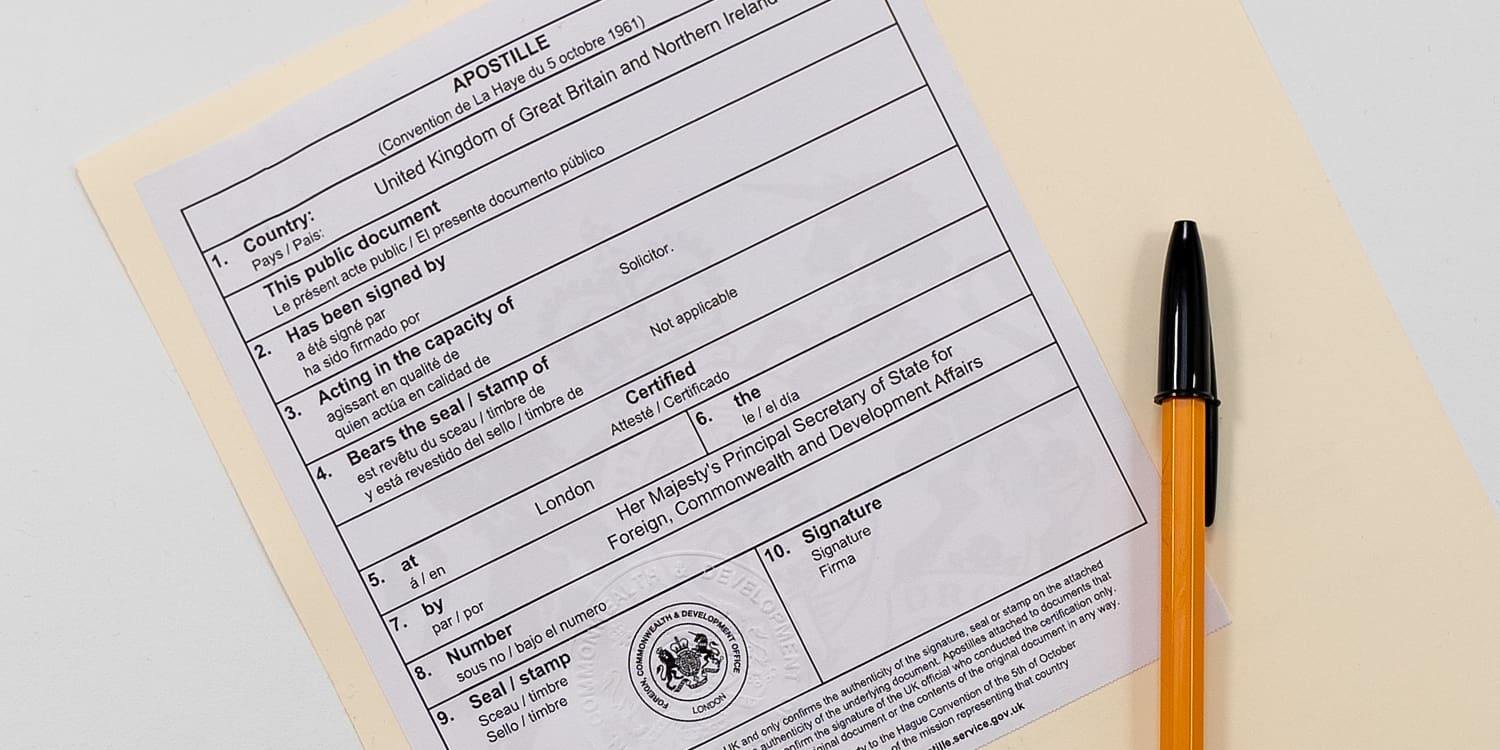
What does the apostille certificate look like?
The certificate is a piece of paper that is glued to the back of the document being legalised. It will also have an embossing of the apostille seal, which is applied to the certificate and goes through to the document itself. If a document is double-sided, the certificate will be placed in the most appropriate space on the document.


The certificate is typically glued to the document across only one edge. This allows for the certificate to be lifted, similar to a page in a book, to ensure that all text in the document remains readable.
Typically, an apostille certificate will contain the following 10 sections:
- Country – in this case, the “United Kingdom of Great Britain and Northern Ireland”
- Name of the person signing the document
- The capacity in which the person is signing the document, such as a solicitor
- Bears the Seal/stamp of – this section will be blank if not applicable
- Place issued
- Date issued
- Issuing authority – in the UK that is, ‘By His Majesty’s Principal Secretary of State for Foreign, Commonwealth and Development Affairs’
- Certificate number
- Stamp of the issuing authority
- Signature of the officer for the issuing authority
Why do non-residents need apostille certificates?
Non-residents of the UK typically require their company documents to be legalised to allow the documents to be recognised in another country. This could be for many business purposes, such as opening a business bank account in their own country, or if they are looking to open an overseas branch.
Opening a business bank account in the UK can be challenging if you do not live here. Many banks will either require you to be a resident or to travel to the UK to set up an account. Because of this, it can sometimes be easier and more practical for the officers of a company to set up a business bank account in the country they live in.
Each bank has its own separate requirements for the documents that need to be apostilled. As a result, you should always check on exactly what is required. This will help prevent the wrong document from being apostilled, thereby delaying the opening of an account.
Where can you use apostilled documents?
A common misconception is that apostilled documents will be recognised in all countries around the globe. They are in fact only accepted in 122 countries. These are the countries that are party to the 1961 Hague Convention.
Once a document has been apostilled, all participating countries to the 1961 Hague Convention will then be able to accept the document. This is advantageous, as it removes the need for the document to be certified again by the country in which the document is intended to be used.
Which documents are apostilled?
Whilst each bank or government organisation will have its own requirements on which documents should be apostilled, the most common documents tend to be those issued by Companies House. These include:
- Certificate of Incorporation
- Memorandum and Articles of Association
- Certificate of Good Standing
- Change of Company Name Certificate
- Annual accounts
- Companies House forms, for example – AP01, CS01, IN01
We hope you found this post of interest. If you have any questions regarding apostille documents, please be sure to leave them in the comments.



Join The Discussion
Comments (8)
I need apostle stamps on my birth and
Marriage certificate in Greece to transfer my property from joint ownership to sole ownership do I need them notarised how do you want me to go about it
Thank you for your kind enquiry, John.
Please email info@1stformations.co.uk with your query, and we will be able to assist you with the apostilling of your documents.
Thank you in advance.
Kind regards,
The 1st Formations Team
Thank you for your explanation.
Which document must be apostille for a non-resident in the UK, especially for e-commerce or drop shipping?
Thank you for your kind enquiry, Seth.
In general terms, the most common documents apostilled tend to be those issued by Companies House – for example:
Certificate of Incorporation, Memorandum & Articles of Association, IN01 Form from Companies House or Certificate of Good Standing.
We trust this information is of use to you.
Kind regards,
The 1st Formations Team
Very interesting! Thanks :)
Hi Amelia
Thank you for your comment. Please let me know if you have any questions.
Best regards,
The 1st Formations Team
Great blog as always! Clear to understand the importance of apostilled documents, especially to Non-UK residents
Hi Daniel
Thank you for your excellent comment and kind words.
Best regards,
The 1st Formations Team