


As household budgets continue to feel the pressure of rising everyday costs, and businesses across several sectors navigate economic uncertainty, including higher energy costs and the growing adoption of AI, many people are exploring new ways to generate income. From side hustles to going all-in on their passions, people are looking to build greater financial resilience. For many, company formation is the next step in turning those ideas into legitimate businesses.
While we’re seeing entrepreneurial ambition on the rise, Google searches for “how to start a side business” have increased by 40% over the past year, while searches for “how to start a small business” have risen by 30%, suggesting more people are exploring how to turn their skills, hobbies, and creative passions into businesses.
To find out which passions people are most eager to monetise and where entrepreneurial ambition is strongest, we analysed Google search data from across the UK’s largest cities.
Using phrases such as ‘how to start a [passion] company’ or ‘how to make money from [passion]’, we analysed average monthly search volumes across a wide range of hobbies and interests – from gaming, content creation, and crocheting to art, music, and baking – to uncover the UK’s most popular passion-led business ideas.
Key takeaways
- London ranks as the UK’s leading business hub for aspiring entrepreneurs looking to turn their passions into businesses based on overall search volume, while Norwich emerges as the country’s leading hotspot for passion-related entrepreneurial interest on a per-capita basis.
- Fashion-focused ventures are the UK’s most popular passion-led business idea, followed by YouTube, influencing, content creation, and blogging.
- 1st Formations company formation expert and CEO Graeme Donnelly shares five practical tips for turning your passion into a business.
What are the passions Brits most want to turn into businesses?
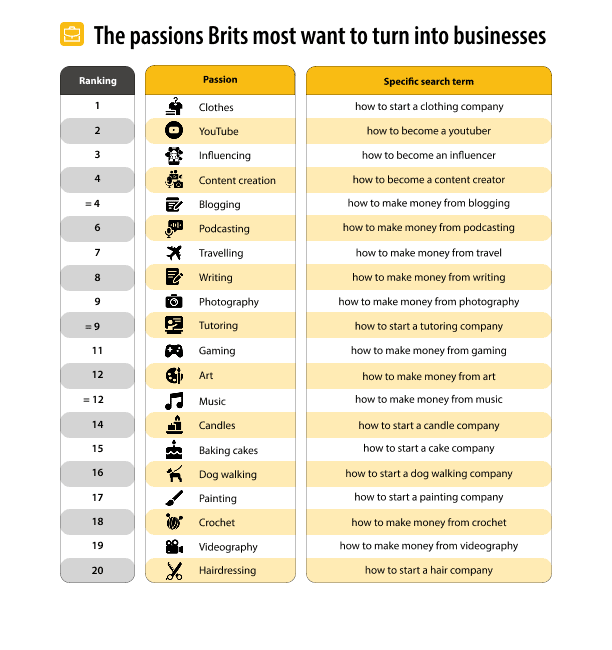
Despite an already competitive fashion industry (there are 11,598 clothing retail businesses in the UK alone), launching a clothing brand remains Britain’s most popular passion-led business idea, attracting aspiring entrepreneurs.
Following clothing, in the top five most-searched-for passions that people want to monetise, are YouTube, influencing, content creation, and blogging. This comes as no surprise, with research showing there are half a million TikTok creators and 150,000 Instagram influencers based in the UK.
Podcasting also ranks among Britain’s most popular passion-led businesses, reflecting the continued growth of the creator economy and digital-first businesses. Following podcasting in the ranking are travelling, writing, photography, and tutoring. With Substack – a platform that allows people to get paid to blog and create written newsletters – revealing it surpassed half a million subscribers in the UK, the popularity of writing as a passion-led business comes as no surprise.


Where in Britain do aspiring entrepreneurs want to turn their passions into businesses?
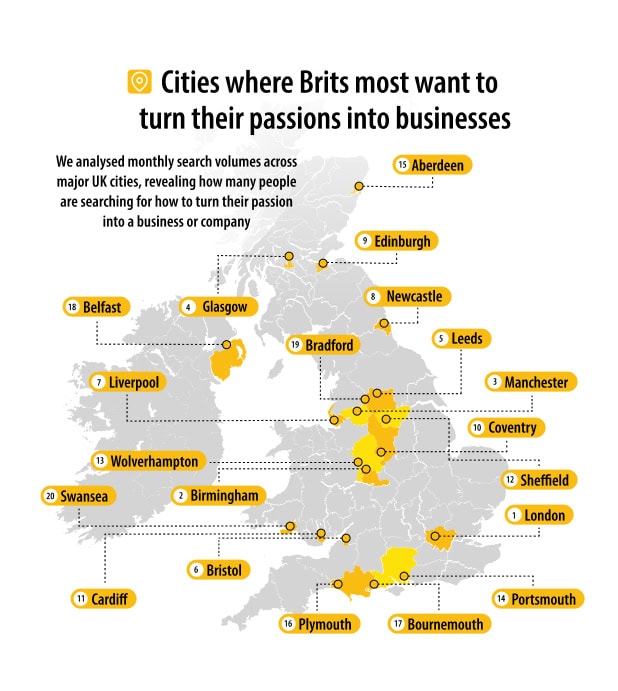
As the UK’s largest business hub, London generates the highest volume of searches from people looking to turn their passions into businesses. This strong interest reflects London’s thriving entrepreneurial scene, extensive networking, and investment opportunities.
London is followed by Birmingham, highlighting a growing appetite for entrepreneurship in the West Midlands. Manchester ranks third, cementing its reputation as one of the UK’s most entrepreneurial cities, while Glasgow and Leeds round out the top five. This suggests that interest in building businesses from personal passions extends well beyond the capital, with major regional cities also embracing entrepreneurship.
While London records the highest search volume overall, the picture changes when population size is taken into account. Birmingham, Manchester, and Glasgow all generate disproportionately high search volumes relative to their populations, suggesting that interest in turning personal passions into businesses is even more concentrated in these cities than in the capital.
When adjusted for population size, the rankings shift considerably. Norwich, Dundee, Oxford, Portsmouth, and Preston emerge as the UK’s top five locations for entrepreneurial interest on a per-capita basis, indicating that the appetite to turn personal passions into businesses is most concentrated in these areas rather than in the country’s largest cities.
Several factors may help to interpret the findings behind this trend. These top five locations are established university cities, with large student and graduate counts. Strong innovation ecosystems and a culture of entrepreneurship may encourage more people to explore self-employment or start their own passion-led business.
Additionally, smaller cities have a lower cost of living and commercial costs than major hubs such as London. Lower overheads can reduce the financial barriers to starting a business, potentially making self-employment feel more attainable for aspiring entrepreneurs.


5 Tips for turning your passion into a business
Turning a passion into a business takes more than enthusiasm. Graeme Donnelly, company formation expert, Founder and CEO of 1st Formations, shares five practical tips for giving your business idea the best possible start:
-
Validate your idea before investing – Research your market, competitors, and target audience before committing money to your business. Utilise search tools and social media to see if there’s a genuine interest for your business before you invest any money. This will save both time and money further down the road.
-
Rome wasn’t built in a day, and neither will yours be – Start small and build gradually. Don’t quit your job straight away (unless you have funds to back up your risk and you want to go all in). Work alongside your full-time job and give yourself time to build up your business.
-
Define what makes your business different and hone in on it with customers – Having a very clear value proposition allows you to stand out in a very saturated market. You don’t need to reinvent the wheel, but you do need to get your product across in a unique way.
-
Think like a business owner from day one, it needs to make a profit – You’re now the head of marketing, bookkeeping, HR, and customer service. Although your passion is your passion, if you want it to generate income, you need to tackle things from a business-first perspective almost immediately.
-
Register your business as soon as you can – Don’t wait for the “perfect time” to register your business because it doesn’t exist. Forming a limited company can make your company look more professional and protect you in multiple ways, from tax to assets.
Conclusion
Turning a passion into a successful business takes more than enthusiasm – it requires planning, perseverance, and commitment. Whether you’re inspired by fashion, content creation, or another creative pursuit, the UK’s growing entrepreneurial landscape shows there’s never been a better time to explore your passion-led business ideas. With the right preparation, solid understanding of your market and expert guidance, your passion could become more than a hobby – it could become your next venture.


Methodology
1st Formations used Google’s Keyword Planner tool to analyse monthly search volumes across major UK cities to reveal which locations are actively searching to set their passion and/or side hustle up as a business or company the most. Historical metrics of average monthly searches were collated, and the seed list of cities was based on the level of size. A range of passions and hobbies were analysed, and we varied longtail search terms – for example, ‘how to start [passion] company’ or ‘how to make money from [passion]’. Data collated in June 2026.



Join The Discussion