
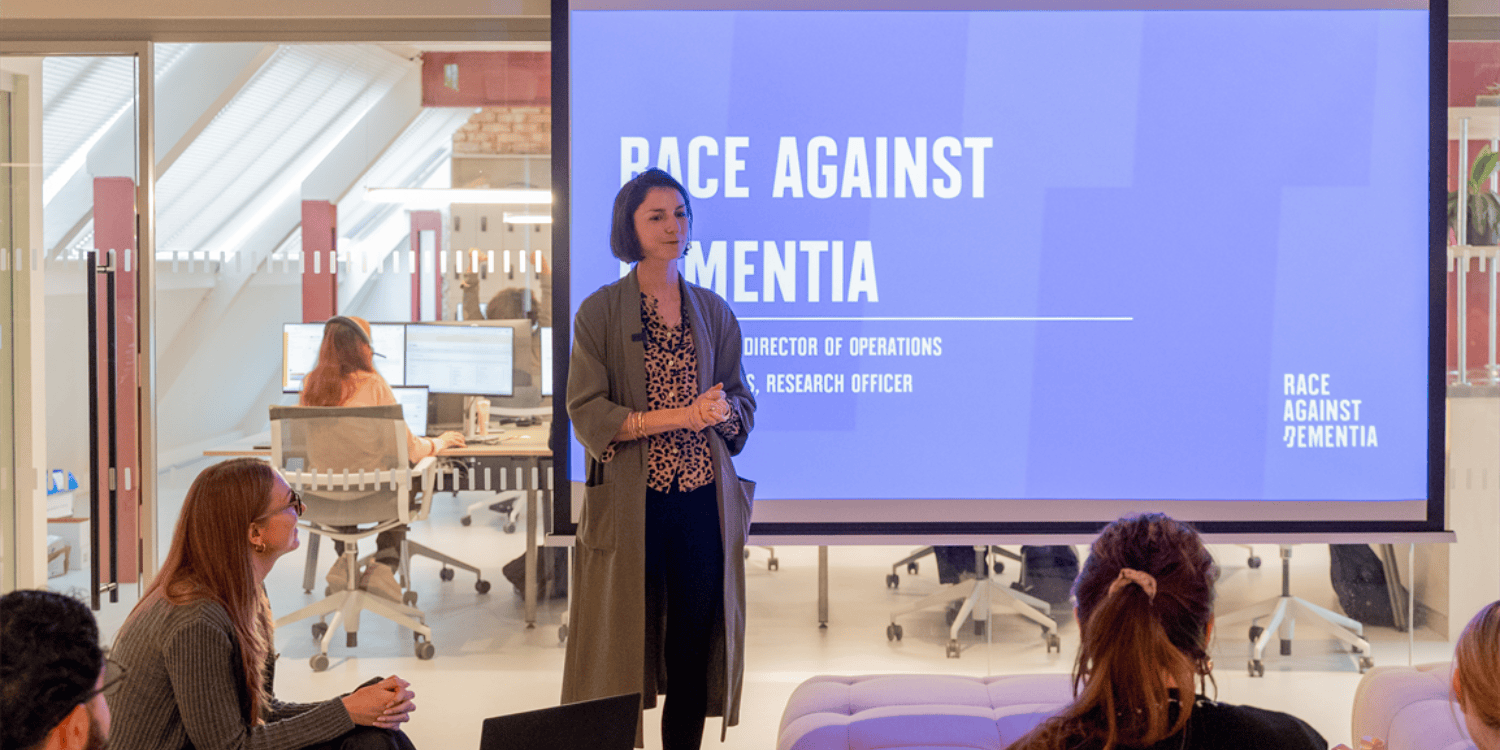

When Formula 1 legend Sir Jackie Stewart’s wife, Lady Helen, was diagnosed with frontotemporal dementia, he channelled his energy and connections into something entirely new: a charity that could bring the pace and problem-solving mindset of motorsport to medical research. Race Against Dementia (RAD) was founded in 2016 to fund and train the next generation of dementia scientists, giving them the tools, mentorship, and urgency needed to drive faster progress towards prevention and treatment.
Nearly a decade on, RAD supports more than sixty early-career researchers across the UK and internationally. It’s a small charity operating with big ambition, built on partnerships between scientists, engineers, and supporters who believe that innovation and collaboration can accelerate change.
“If there’s a problem with a car, it needs to be fixed by the next day,” says Lydia Beaton, Race Against Dementia’s Director of Operations – and that’s the spirit the charity tries to emulate.
This article looks at how Race Against Dementia combines the best of Formula 1 thinking with world-class science – and how partnerships like this one show what’s possible when businesses put their skills and resources to purposeful use.
Key takeaways
- Race Against Dementia equips scientists with Formula 1-inspired training to fast-track breakthroughs in dementia research.
- Donated office space enabled RAD to collaborate more effectively, cut costs, and expand fundraising capabilities.
- Skill-sharing and infrastructure support often make a bigger impact than financial donations for small, high-impact charities.
Bringing Formula 1 principles into the lab
At its core, Race Against Dementia funds early-career scientists whose ideas have the potential to lead to significant breakthroughs in understanding, diagnosing, and treating dementia. There are currently 65 RAD researchers worldwide – 55 of them based in the UK – working on projects that range from AI-driven drug screening to next-generation diagnostic tools.
- Corporate volunteering days with the WONDER Foundation
- Supporting charities with vacant commercial space
- How to set up a charity in the UK
RAD funds early-career researchers and then goes a step further, equipping them with the tools and training to work at the pace modern science demands. Fellows take part in a bespoke performance programme modelled on Formula 1 teams, learning how to operate under pressure, solve problems fast, and collaborate across disciplines. Each year includes a week-long in-person training event, as well as virtual coaching sessions every other month. Lectures come not just from scientists, but also from engineers and leaders in various industries, from motorsport to business.
“As well as funding, we provide training,” Beaton says. “We put researchers on a training programme where they receive lectures from people in F1 and other industries. There’s a week-long in-person training held once a year, and virtual sessions are held every other month. They also receive performance-based coaching – learning how to peak at the right moment. The whole essence of RAD is learning from other industries.”
That cross-sector model is part of what makes Race Against Dementia unique. It’s a research charity that operates with the energy of a start-up, continually refining its support for its people.
The reality of running a small, high-impact charity
Despite its high-profile founder and global reach, Race Against Dementia operates with the pragmatism of a lean business. Fundraising is one of the biggest challenges, according to Beaton: “As generous as people are and want to be, it’s not always easy for them to make significant donations. That’s why we have to work more creatively to raise funds.”
Behind the scenes, that includes work many companies will recognise: CRM upgrades, digital transformation projects, marketing automation, and data systems. These tools help RAD connect with donors, manage events, and measure impact, but they also require expertise and investment. “The biggest challenge is knowing where and how to invest responsibly. We want to grow, but we also need to ensure we’re using money wisely.”


That’s where business partnerships make a difference. For smaller charities, financial donations are valuable, but so is access to workspace, mentoring, and technical support. Beaton notes that one of RAD’s most valuable partnerships in the past year has not come through funding, but through infrastructure – specifically, a London base provided by 1st Formations.
A small gesture with large-scale benefit
Since 2024, Race Against Dementia’s team has been working from unused office space donated by 1st Formations in the heart of London. For the charity, the impact has been transformational.
Having the office space gifted to us is of huge benefit. It means we can reallocate those funds to accelerating dementia research and supporting our mission.
Before moving in, the RAD team was fully remote. Having a central base has enabled them to host donor meetings, collaborate more effectively, and even manage logistics that were previously impossible. “Now we can work together in person, collaborate easily, and even store materials like banners and event kits – something hot-desking wouldn’t allow.”
“A great example of the office supporting our work is with the prize draw competition we’re running,” Beaton says. “Legally, when you have a paid-entry competition, you must offer a free postal entry option. So we asked Graeme if we could use this address as the official free-post address, in case we get hundreds of entries. Without an office, that would’ve been impossible.”
It’s a clear example of how non-financial support can directly enable a charity to operate more efficiently. The office also serves as a morale booster, offering a professional and central environment that helps attract and retain staff in a sector where salaries are often modest.
It’s incredibly motivating for the team to be in a central location. We can’t always be overly generous with benefits, so location helps with both attracting and retaining talent. Having a dedicated professional space is also important for hosting meetings with donors.
Why partnerships, not just donations, matter
For many organisations, the idea of supporting a charity still defaults to writing a cheque. However, as Beaton points out, corporate social responsibility has undergone a shift. These days, Beaton says, companies are keen to provide “opportunities for employees to feel proud and personally connected to the charity they’re supporting”. This model of skill-based giving is a powerful form of employee engagement: instead of donating in isolation, staff can participate in mentoring sessions, offer professional advice, or contribute to a specific project.
Race Against Dementia has already benefited from this approach through connections made by ASTOP, the organisation that facilitated the partnership with 1st Formations. For Lydia Beaton and her team, that connection opened the door to new relationships, ideas, and opportunities. “There’s often just a lack of awareness – people might not realise they could meaningfully support a smaller charity.” In reality, however, she points out that “even things like offering charities a space for a day a week, or sharing knowledge and resources, can make a big difference.”
How businesses of any size can make a difference
You don’t need to be a global corporation to have an impact. Partnerships like the one between 1st Formations and Race Against Dementia show that even small, practical contributions can transform how a charity operates day to day.


Unused meeting rooms can become planning spaces for campaign teams. Redundant office furniture or IT equipment, such as chairs, monitors, and laptops, can help charities build a comfortable and functional workspace without diverting funds from their core mission. Marketing or finance teams can share their expertise through short-term volunteering or mentoring sessions.
A modern approach to corporate social responsibility
The pandemic years prompted a major re-evaluation of what work and professional purpose mean. As employees seek more meaning from their jobs, CSR has become an increasingly important part of company culture. Surveys also show that younger employees, in particular, want to work for businesses that take social impact seriously, not just in principle, but in practice.
Providing a charity with professional resources or access to your team’s expertise sends a clear signal: that your company is committed to the long term, to community, and to helping solve complex problems through collaboration.
It also strengthens teams internally. Employees who participate in volunteering or pro bono projects often report higher morale, stronger engagement, and a renewed sense of purpose. In many cases, the benefits ripple far beyond the charity partnership itself. As Beaton points out, if those at the top care, “it filters down into the company culture.”
What’s next for Race Against Dementia?
Race Against Dementia has several major initiatives underway that show how far the right support can go. Lydia Beaton told us the team is preparing to launch a fundraising competition with an all-expenses-paid trip to the Abu Dhabi Grand Prix as the top prize.
The campaign will also feature a replica Formula 1 helmet signed by every living World Champion, including a rare signature from Michael Schumacher, secured with the help of his wife. The funds raised will go towards a new fellowship programme supporting researchers who are using AI and machine learning to accelerate dementia research.
How to get involved
If you’re a business owner or professional wondering how to support a cause you care about, start small. Audit what you already have: a spare meeting room, unused laptops, marketing expertise, or team volunteering days. Each of these can be invaluable to a charity trying to stretch every pound as far as possible.
It’s a reminder of how much progress is possible when charities have the space and support to do their best work. To learn more about Race Against Dementia, its mission, and how you can help, visit the Race Against Dementia website. And for businesses with unused offices or commercial space, ASTOP helps connect landlords and property owners with charities in need of a base – creating partnerships that turn empty rooms into places of real purpose.


Join The Discussion