

Corporate Social Responsibility (CSR) is when a business aims to contribute to the well-being of society and the environment. This includes responsible consumption, ethical sourcing, employee welfare, and community engagement.
For small and medium-sized enterprises (SMEs), CSR is a practical and thoughtful business approach that’s quickly becoming a core strategy and value for leaders around the world. Skillsoft’s CSR Report 2023 shows that 70% of companies have created a CSR budget and 55% increased it since the previous year.
For those practising CSR, it can enhance brand reputation, attract ethically minded customers and recruits, and future-proof the company as social and environmental expectations continue to rise.
Looking to introduce CSR in your business? Read on to learn what CSR means, understand your legal responsibilities, and find out how to integrate these principles into your operations.
Key takeaways
- Implementing a tailored CSR policy enhances brand loyalty and attracts ethically minded customers and employees.
- Regularly review CSR policies to align with evolving public attitudes and to avoid alienating your customer base.
- Compliance with regulations, such as gender pay gap reporting, demonstrates commitment to social responsibility and ethical business practices.
What is Corporate Social Responsibility (CSR)?
Corporate Social Responsibility (CSR) is about how a business chooses to do the right thing by considering its impact on people, communities, and the planet. CSR includes actions like reducing energy use and waste, supporting employee health and well-being, promoting fairness and inclusion, making sure suppliers treat their workers ethically, and giving back through education or charity. Let’s explore each of these areas in more detail.
Environmental responsibility
Environmental responsibility is a core part of CSR, focusing on how a business reduces its impact on the planet. This ties closely to Environmental, Social, and Governance (ESG) principles – standards investors, regulators, and customers often use to assess a company’s ethical and sustainable performance.
- Earth Day 2026: Our Power, Our Planet
- Corporate volunteering days with the WONDER Foundation
- 5 tips to manage health and safety at work
For SMEs, this means going beyond short-term fixes and embedding environmental responsibility into everyday decisions. Many businesses choose to implement an Environmental Management System (EMS) to manage their environmental responsibilities. However, even small changes like lowering energy use or reducing waste support CSR aims and build stronger, more future-focused businesses.
Employee health and well-being
All companies have a legal duty of care. While all employers must meet these standards, many SMEs go beyond the basics, creating a supportive environment that prioritises both physical and mental health. This includes offering access to mental health resources, counselling services, and stress management training.
They also promote healthier work routines, such as encouraging employees to take regular breaks and offering flexible working arrangements. These proactive actions can lead to better staff retention, increased productivity, and a stronger workplace culture.
Promoting workplace diversity and equality
Any business with employees must ensure there is no workplace discrimination under the Equality Act 2010. This means treating everyone equally, no matter their age, sex, race, disability, or any other protected characteristic.


Like with employee well-being, many companies go a step further, ensuring that leadership teams, such as boards and senior management, reflect a balance of genders, backgrounds, and perspectives. Others practice voluntary gender gap reporting or blind recruitment, a hiring practice that removes identity information (gender, age, ethnicity) from applications to reduce bias and promote a fair selection process.
However, it’s important to approach this responsibly. While encouraging diversity is a key part of CSR, you should also avoid positive discrimination – where someone is treated more favourably specifically because of a protected characteristic. This can be unlawful under the Equality Act 2010.
Ethical supply chains and human rights
Practising CSR isn’t just about how you treat your team; it also means thinking carefully about the partners you work with and how they operate.
Even if you run a local business, your supplier may operate in different regions with different labour standards from yours. It’s crucial that the people behind your products and services are treated fairly and ethically. This might involve asking questions about their working conditions, fair pay, or environmental practices, or ensuring all suppliers agree to a Supplier Code of Conduct.
For SMEs, setting clear expectations and choosing suppliers that share your values can make a real difference. Ethical sourcing supports your CSR goals, builds trust with customers, and helps protect your brand from potential risks linked to poor labour or human rights practices.
Education and community involvement
Socially responsible businesses look for ways to empower people and give back to the wider community. Some companies support staff development through training or apprenticeships, helping build a skilled and motivated workforce.
Many also give back to their communities by sponsoring local causes or offering employees time to volunteer. These activities strengthen local ties and can enhance your business’s reputation.
Looking for ways to give back? Take a look at how 1st Formations supports the local community.
Why CSR is important for your business
CSR is a strategic approach that balances profits with purpose. How? Here are the top three benefits of CSR in business.
Enhance brand reputation
Demonstrating a clear commitment to ethical and sustainable values can set your business apart. Customers and partners are more likely to trust and support brands that show transparency, care for the environment, and contribute to social good. A well-communicated CSR strategy builds credibility and loyalty, especially in a market where conscious buying is on the rise.
Attract and retain top talent
Today’s workforce, particularly younger employees, increasingly seeks employers whose values align with their own. A visible commitment to CSR can make your business more attractive in a competitive job market. CSR also fosters a sense of purpose and belonging, leading to higher job satisfaction, engagement, and retention.
Meet customer and investor expectations
Sustainability and social impact are now key criteria for purchasing and investment decisions. Consumers are asking more questions about how brands make their products, while investors factor Environmental, Social, and Governance (ESG) performance into risk assessments. Aligning your CSR efforts with these expectations positions your business for long-term resilience and growth.
CSR in practice: Ella’s Kitchen
Ella’s Kitchen, an organic baby food company, is just one example of how UK SMEs are building reputable companies on ethical and socially responsible principles. They prioritise environmentally responsible packaging, carbon reduction efforts, and community outreach.
Their mission is “to help every little one grow up happy, healthy, and never hungry; and on a planet that has plenty of food and is buzzing with life.” How do they stay true to that mission? They:
- Work with schools to support healthy eating campaigns
- Are a certified B Corp
- Raise money for local charities like Action for Children
- Protect our wildlife by volunteering with RSPB
- Support children’s learning and development by running food play lessons
- Help their employees grow through mentorship schemes
- Partner with responsible suppliers to produce up to 75% recyclable packaging

Ella’s Kitchen shows that even as a small business, it’s possible to make a big impact by embedding corporate social responsibility into your operations. CSR doesn’t have to be costly or complicated; what matters is authenticity and a genuine commitment to creating positive change for people and the planet.
How to create a CSR policy for your company
Ella’s Kitchen shows that even as a small business, it’s possible to make a big impact by embedding CSR into your operations. CSR doesn’t have to be costly or complicated; what matters is authenticity and a genuine commitment to creating positive change for people and the planet.
Audit your current practices
Start by reviewing what your business is already doing. Look at your operations, supplier relationships, employee practices, energy use, and community involvement. Are there any ESG efforts already in place? This honest look will help identify strengths and areas for improvement.
Define your CSR objectives
Decide what matters most to your organisation and set clear, achievable goals. Focus on areas that align with your company’s values and capacity, whether that’s reducing energy consumption, improving staff wellbeing, or supporting a local charity.


Keep your objectives measurable and realistic. For example, you could aim to cut paper use by 50% in 12 months or host quarterly well–being sessions for staff. A focused plan will help you make meaningful progress without overstretching your resources.
Communicate with and train your team
Your CSR policy will only work if your team understands it and knows how to support it. Share your goals, explain why they matter, and involve staff in the process.
Offer training sessions or team briefings to build awareness and engagement. Remember to encourage staff input – they likely have plenty of excellent ideas.
For free tools and templates, explore Acas’ Equality and Diversity Resources.
Measure and review your CSR policy regularly
As your trends evolve and your business grows or changes, your CSR policy should update, too. So, track your progress regularly to see what’s working and where you can improve.
A great place to start is to set a review date every 6–12 months. Look at key areas like energy usage, staff feedback, or community activities. Regular updates help keep your efforts relevant and effective.
Your CSR audit checklist
Use the template below to track your CSR progress. Create these simple checklists for individual CSR focus areas, including sustainability, community involvement, and ethical sourcing.
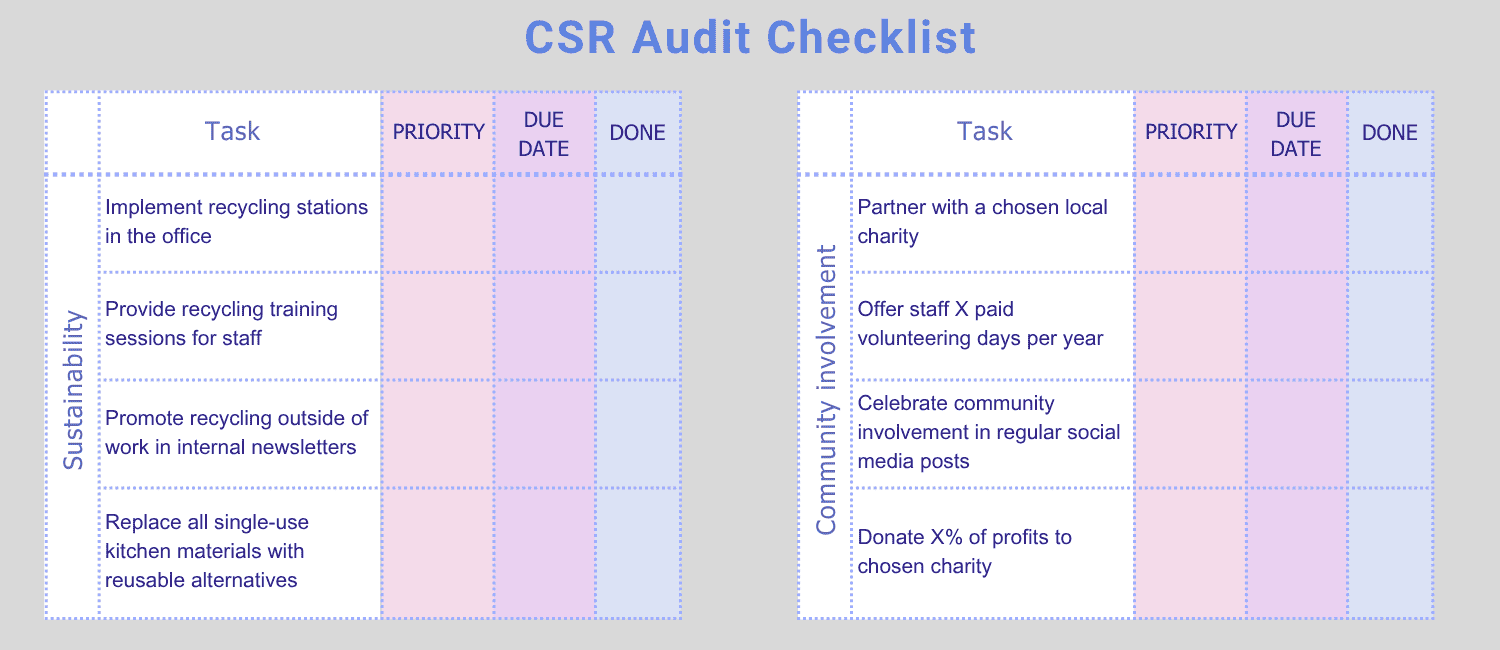
Creating and improving CSR is perfectly achievable even for small businesses where time and resources are often limited. Take these simple steps to build a responsible brand that benefits both your community and your bottom line.
Legal responsibilities related to CSR
Aside from the regular employment laws, there are certain legal responsibilities relating to CSR for companies to be aware of. Under the Equality Act 2010 (Gender Pay Gap Information) Regulations 2017, all companies with at least 250 employees must publish their gender pay gap data every year. The data specifically includes the:
- Mean gender pay gap in hourly pay
- Median gender pay gap in hourly pay
- Mean bonus gender pay gap
- Median bonus gender pay gap
- Proportion of males and females receiving a bonus payment
- Proportion of males and females in each pay quartile
Meanwhile, the Companies (Strategic Report) (Climate-related Financial Disclosure) Regulations 2021 mandate some of the UK’s largest companies to disclose climate-related financial information.
Start building a responsible business today
CSR is a vital part of doing business in an ethical, sustainable, and people-focused way. From reducing your environmental impact and supporting employee well-being to promoting diversity and giving back to your community, even small, simple actions can make a lasting difference.
Already a business owner? Follow the four steps in this blog to create your own CSR policy.
If you’re ready to put your values into action, start your CSR journey by forming an ethical company with 1st Formations. Explore our registration packages designed with compliance and responsibility in mind.





Join The Discussion